
Your Family Doesn't Need to Match. They Need to Coordinate.
Here's the quiet truth about dressing your family in coordinated outfits: you only get a handful of years where your kids will actually want to do it. That window is small, and it closes faster than you expect. So the question isn't whether to match. It's how to do it well.
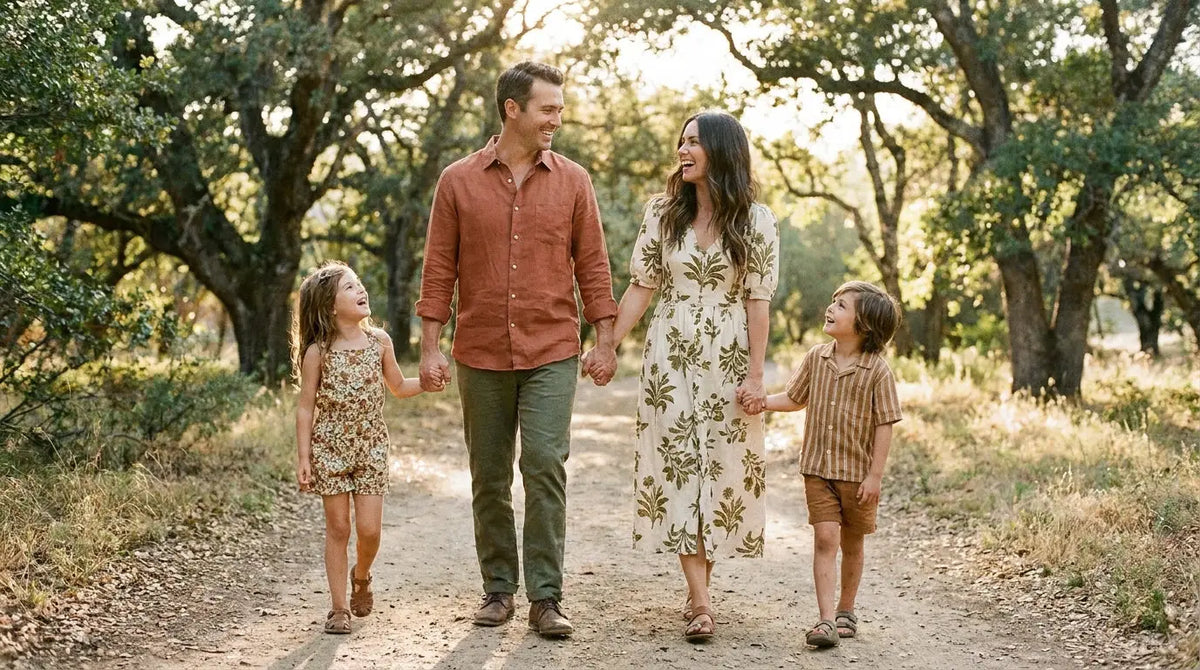
The biggest misconception about matching family outfits is that everyone needs to wear the same thing. They don't. Matching means visually connected, not identical. And the shift is unmistakable: families are moving away from head-to-toe mini-me replicas and toward shared color palettes, complementary silhouettes, and a single print element that ties the whole look together.
By the end of this guide, you'll know exactly what separates a polished, coordinated family look from something that feels like a costume.
The Costume Test (And How to Pass It)
There's a simple way to evaluate any coordinated family outfit. We call it the costume test: if your family could walk into a Halloween party and nobody would blink, you've gone too far.
What makes a look read as a costume? Matching every single element. Same color, same silhouette, same print, same accessories. When nothing varies, individuality disappears. You're not wearing outfits anymore; you're wearing uniforms. And uniforms, however cute in concept, flatten the personality out of every person in them.
What reads as intentional is different. Sharing two or three elements (a color palette, a texture, or a single print) while letting each piece vary by cut, weight, or detail creates something that looks purposeful rather than prescribed. This is the principle that fashion photographers and stylists consistently return to: coordinate, don't clone.
Here's a concrete example. Imagine a graphic tee for the kids in a bold print. A solid tee for dad in the print's anchor color. A printed set for mom that carries the full pattern. Same story, three different voices. Each person looks like themselves. Together, they look like a family.
This matters beyond aesthetics, too. The matching family outfit market in the US is projected to reach $12.5 billion by 2030, and the luxury family-matching segment is growing at a 14% compound annual rate. Families are investing in this category, and the ones who get the most wear out of their pieces are the ones who coordinate rather than duplicate.
Four Styling Rules That Keep Coordination Looking Intentional
Think of these as the practical toolkit. They're the same principles stylists and photographers use on set, distilled into something you can apply on a Tuesday morning.
Rule 1: The Anchor Outfit Method
Start with the most expressive piece in the family. That's usually the printed garment, the boldest color, or the most detailed item. Build every other family member's look around its colors, textures, and formality level. The anchor outfit sets the tone; everyone else harmonizes with it.
Rule 2: The Rule of Three Colors
Pick three colors that appear across everyone's outfits. Three is the sweet spot. It creates unity without uniformity, and it photographs exceptionally well. Pull those three from your anchor piece and you've already done the hardest part.
Rule 3: Limit the Pattern
Keep patterned pieces to one or two family members, maximum. Dress the others in coordinating solids. This prevents visual clutter and keeps the overall look clean and intentional rather than busy. When everyone wears a bold print, no single piece gets to shine.
Rule 4: Mix Textures Deliberately
A waffle-knit on one person, a smooth jersey on another, a linen blend on a third. When they share the same color story, the texture variation adds visual depth that flat, identical fabrics can't. This is especially effective in photos, where light catches different surfaces in different ways.
Let the Print Do the Work
Print-led coordination is the most sophisticated approach to family matching, and it remains the most underused. Rather than starting with a color and hunting for pieces that happen to share it, you start with one original, expressive print and let it tell the whole story.
A strong print carries its own color palette. Pull its tones for your solids. Let its mood guide your silhouette choices. Match its formality level to the occasion. The print becomes the anchor, and everything else falls into place around it.
There's a nuanced technique most styling guides skip: scale variation. Wearing the same print at different scales across family members (larger on an adult, smaller on a child) creates cohesion that feels sophisticated rather than literal. It's the difference between echoing a motif and stamping it.
The Spring/Summer 2026 runways saw a strong return to bold, expressive, hand-drawn prints after several seasons of muted minimalism. Consumers are actively seeking prints that feel human and crafted, a direct counter to the mass-produced matching set aesthetic that dominated the last decade.
This is where our collections at Pip & Moon fit naturally. Every print we release is original and hand-drawn in our Atlanta studio, inspired by the landmarks and light of Rio de Janeiro: the wave pattern of the Copacabana promenade, the mosaic colors of the Selarón steps, the amber glow of a Laranja sunset. These aren't stock designs. They're coordinated across women's, men's, and children's sizing (XS through XXL for adults, 2T through 14 for kids), so the whole family wears the same print in a fit made for their body. No styling guesswork required.
A strong print anchors the look so the rest of the family's pieces can be simpler. Less effort, more impact.
Beyond the Photo Shoot: Coordinating for Everyday Life
Most family matching guides are written for holiday cards and portrait sessions. But the real shift is that millennial parents are treating coordinated family looks as a lifestyle choice, a form of shared experience built into daily life rather than saved for a single occasion. Google Trends data backs this up: search interest in matching family outfits peaks at 95 in November, but recovers to 68 by April, showing sustained demand well beyond the holiday window.
The "dadcore" influence has played a real role here. Relaxed, breathable, practical silhouettes for men are making full-family coordination feel natural and unforced. This category is no longer just mom-and-kids territory. When dad's piece fits his style and his life, the whole family actually wants to wear it.
There's also a significant gap the market hasn't fully addressed: moms of sons and gender-neutral families. The matching outfit category skews heavily toward dresses and skirts, which leaves a lot of families out. Coordination through separates, unisex silhouettes, and shared color palettes serves the full family unit, not just the mother-daughter default.
Elevated loungewear is one of the strongest threads running through family style right now. Pieces designed to move from home to a coffee run to a casual dinner without a wardrobe change are the practical backbone of an everyday coordination wardrobe. Choosing versatile, high-quality pieces that each family member can also wear separately (not just as a set) is the smarter, more sustainable long-term approach to family matching.
The Look That Feels Like Your Family
Coordinating outfits with your family is a time-limited ritual. Kids grow out of it, literally and figuratively. So the goal isn't to do it perfectly. It's to do it in a way that feels genuinely like you.
The best coordinated family look isn't the most matchy. It's the most cohesive, the most comfortable, and the most honest to each person wearing it. Pick one print or one color story. Anchor it to the most expressive piece. Let everyone else's individuality come through in cut and texture.
Getting dressed together is one of the small, beautiful things families do while they can. Make it count. Make it yours.
Comments